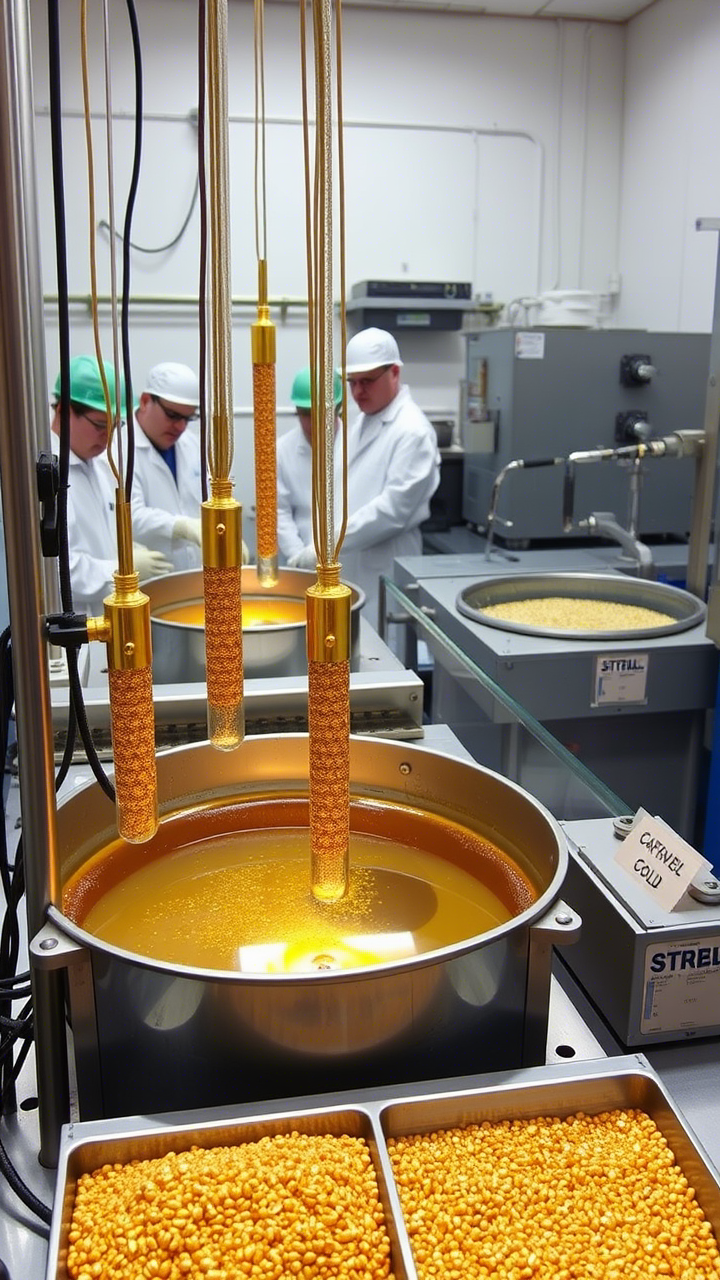
After melting and testing, your gold enters the purification stage. Here, we apply advanced chemical and electrochemical methods to remove every trace of impurity — turning rough gold into a precious, pure element.
For most batches, we use electrolysis — the safest and cleanest method to extract pure gold.
The melted gold is cast into anodes (thin plates) and placed into an electrolyte bath.
A current is passed through the solution, causing pure gold to migrate to the cathode, leaving impurities behind.
This method can produce gold of 99.99% purity (24K).
✅ Best for:
Scrap gold
Jewelry returns
Bulk batches requiring consistent results
When electrolysis is not suitable (e.g. for smaller or highly mixed batches), we use Aqua Regia, a mix of nitric and hydrochloric acid.
The gold dissolves into the solution while other metals are filtered out.
Gold is then precipitated, rinsed, dried, and melted again to form pure granules or bars.
✅ Best for:
High-karat jewelry
Dental or electronic gold
Mixed scrap lots
Regardless of method, we ensure all base metals (copper, silver, zinc, lead, nickel) are completely removed.
Final purity is confirmed by post-refining XRF or fire assay.
The gold is now bright yellow, soft, and ready for casting or storage.
After purification, gold can be converted into:
Granules (small beads for re-melting)
24K bars
Casting grain for jewelry manufacturing
🌱 Environmental Responsibility
We follow eco-conscious protocols:
Acid waste is neutralized before disposal
Metal residues are filtered, recycled, or recovered
Our facility uses closed-loop systems to minimize environmental impact